


Short answer: for most tropical houseplants, a well-designed self-watering planter beats a regular pot on plant health, on time, and on mess. For cacti and succulents, a regular pot with fast-draining soil wins. Here's the longer answer, including the cases where self-watering goes wrong and how to avoid them.
How a regular pot waters a plant
You pour water on top. It runs through the soil, some of it soaks in, the rest drains out the bottom into a saucer. For the next day or two the soil is saturated and the roots are short on oxygen. Then it dries from the top down, and by the time the surface looks dry, the bottom is often still wet. You water again based on a guess. Most houseplant deaths come from that guess being wrong in one direction or the other.
How a self-watering planter waters a plant
A reservoir sits below the roots. The substrate wicks water upward, so the root zone stays evenly moist and the plant takes what it needs. You refill the reservoir when a gauge tells you to. The soil never floods and never fully dries.
That's the principle. The execution varies a lot, which is why self-watering pots have a mixed reputation.
Where cheap self-watering pots go wrong
- Soil in a wicking pot. Potting soil wicks too well. It stays saturated, goes anaerobic, and the roots rot. This is the single most common failure and the reason "self-watering pots cause root rot" is a thing people say.
- No gauge. If you can't see the water level, you overfill or forget. Either defeats the purpose.
- Roots in the water. Some designs let the root ball sit directly in the reservoir. That's a hydroponic setup without the aeration, and it fails the same way soggy soil does.
- Plastic. Not a plant-health problem, but it's why most people don't want a self-watering pot in the living room.
How Plantwell handles those
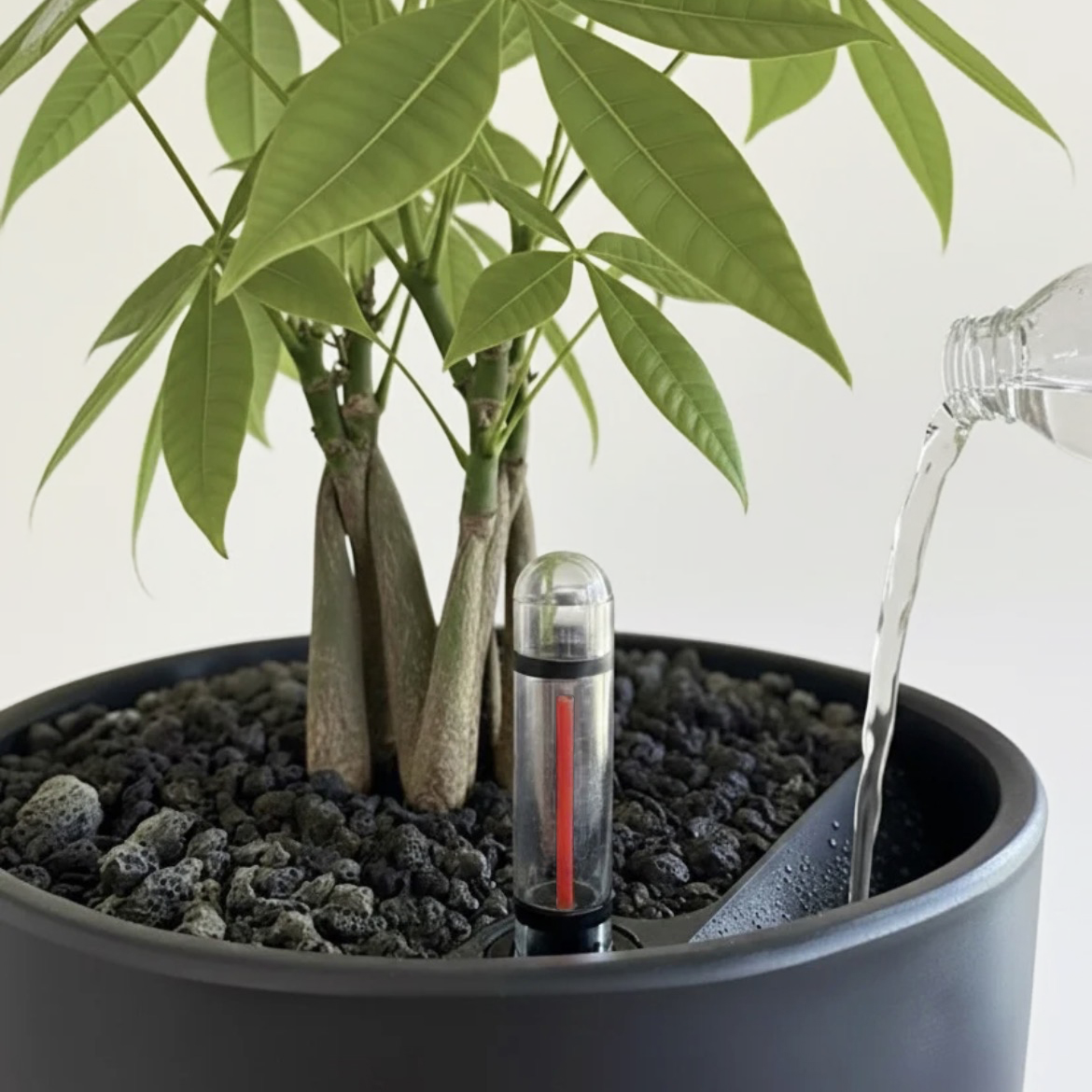
We skip the soil entirely. Every planter ships with Grava, a soil-free blend of porous lava rock and tree fern fiber, made in the USA. The plant is repotted bare-root into Grava inside a black insert with wicking legs. The insert sits in the ceramic pot above the reservoir, so roots get moisture from below and air from the gaps in the rock. A red gauge shows the water level; you fill through a side port until it reads MAX.
The result is a planter you refill every three to four weeks instead of watering every few days, with no gnats (nothing for them to breed in), no compaction, and no drainage hole, so it sits on wood furniture without a saucer.
Regular pot vs self-watering: side by side
| Regular pot with soil | Plantwell self-watering planter | |
|---|---|---|
| Watering frequency | Every 3 to 7 days, by guess | Every 3 to 4 weeks, by gauge |
| Moisture at the roots | Swings from saturated to dry | Steady |
| Air at the roots | Low right after watering | Constant (porous substrate) |
| Fungus gnats | Common | Rare; no soil to breed in |
| Saucer or drips | Yes | No drainage hole, no saucer |
| Travel | Need a plant sitter after about a week | Fill to MAX before you go |
| Repotting | Every 1 to 2 years as soil breaks down | Once; top up the Grava yearly |
| Cacti and succulents | Good | Not recommended |
Which plants belong in which
Self-watering, happily: monstera, pothos, philodendron, rubber tree, money tree, dracaena, dieffenbachia, orchids, peace lily, most tropical foliage plants. Anything that in nature grows in a consistently damp, airy spot.
Regular pot: cacti, most succulents, snake plant if you're a chronic overwaterer, and anything that needs to dry out completely between waterings. These plants evolved for drought cycles and a reservoir removes the cycle.
Cost
A decent ceramic pot with a saucer runs $30 to $80. The Plantwell Pacific starts at $59 with the reservoir, insert, gauge and enough Grava to plant it, so for most people the self-watering version costs about the same as the pot they'd have bought anyway. The hand-thrown Leucadia ($145) and Torrey ($200) are stoneware made in San Diego and guaranteed for life against cracks, chips and leaks.
Frequently asked questions
Is a self-watering planter good for beginners?
Yes, more so than a regular pot. The gauge replaces the judgment call that trips up most new plant owners.
Can I overwater a self-watering planter?
Not if you stop at MAX. The plant draws only what it uses. If you overfill, tilt the planter gently over a sink to let the excess out of the port.
Do I have to repot?
Yes, once, bare-root into Grava. It takes about ten minutes. We explain it step by step in How It Works.
What size do I need?
Medium for plants up to about 18 inches tall, Large above that. Exact dimensions for every Plantwell planter are on the FAQ.


