


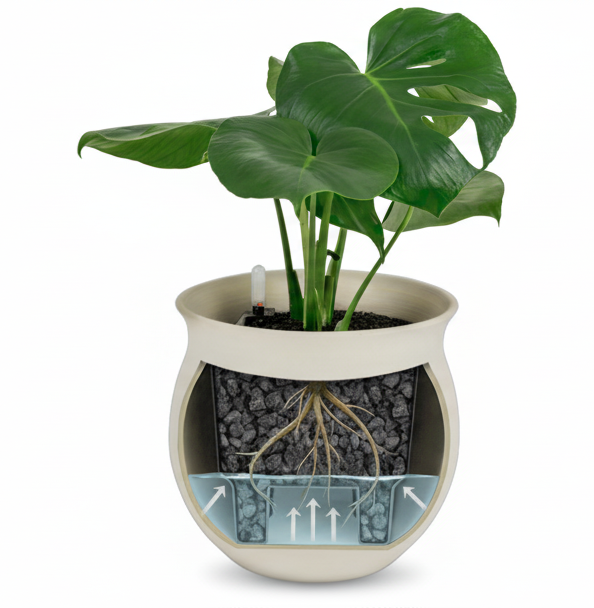
Monstera deliciosa is the plant people most often ask us about, and for good reason. It gets big, it drinks a lot, and it hates two things in equal measure: drying out completely and sitting in wet soil. A self-watering planter solves both problems at once, but only if the planter is built the right way. Here's what to look for, which Plantwell planter fits which size of monstera, and how to repot one without losing leaves.
What a monstera actually needs from a planter
Monstera roots want steady moisture and plenty of air. In a regular pot with soil, you get one or the other: water thoroughly and the soil goes airless for days, let it dry and the fine roots die back. The plant survives by swinging between the two, which is why monsteras in soil so often have yellowing lower leaves and brown edges.
A good self-watering planter keeps the root zone evenly moist from below while leaving air around the roots. That means three things matter more than anything else:
- A reservoir that wicks, not floods. The roots should sit above the water line and draw it up, never in it.
- A substrate that holds air. Soil compacts and goes anaerobic when it stays wet. You want something porous.
- A way to see the water level. Otherwise you're guessing, which is what you were trying to stop doing.
Why we don't use soil
Every Plantwell planter ships with Grava, our soil-free substrate: porous lava rock blended with tree fern fiber, made in the USA. The rock wicks water up from the reservoir and keeps air pockets around the roots. The fiber holds moisture and feeds the plant for about a year. The plant is repotted bare-root into Grava inside a black insert with wicking legs; the insert sits in the ceramic pot above the reservoir and draws water as the plant uses it. A red gauge shows the level. Fill until it reads MAX, then refill when it drops.
For a monstera, that means the roots are never soggy and never bone dry. In our experience that's when monsteras put out the big fenestrated leaves fastest.
Which Plantwell planter for which monstera
Sizing is about root mass, not leaf span. A monstera that's 18 inches or shorter from the surface of the substrate to the top leaf is a Medium. Anything taller, or anything with a moss pole, is a Large.
| Planter | Medium (plants to 18 in) | Large (plants above 18 in) | Price |
|---|---|---|---|
| Pacific, matte black or white | 6.5 in wide x 6.7 in tall | 7.8 in wide x 8 in tall | $59 / $65 |
| Leucadia, hand-thrown stoneware | 7.5 in wide x 7 in tall | 9 in wide x 8.5 in tall | $145 / $175 |
| Torrey, hand-thrown, tall form | 6.5 in wide x 10 in tall | 7.5 in wide x 12.5 in tall | $200 / $235 |
For a young monstera with four to eight leaves, the Pacific Medium is the sensible pick. For a mature plant you plan to stake, the Leucadia Large gives the widest, most stable base. The Torrey Large is the one to choose if you want height on the floor; its tall form balances a leggy monstera visually and the extra reservoir depth means longer gaps between refills.
How often you'll refill
For the first few weeks, every one to two weeks, while the Grava saturates and the plant grows new water roots. After that, every three to four weeks for most monsteras. A big plant in a bright window will land at the three-week end. Tap water is fine.
Repotting a monstera into a self-watering planter
- Pull the plant from its nursery pot and rinse all the soil off the roots under lukewarm water. Be thorough; soil left on the roots is the one thing that can cause rot in a wicking system.
- Set the plant in the black insert and fill around the roots with Grava. Firm it gently so the plant stands on its own.
- Drop the insert into the planter. Fill through the side port until the red gauge reads MAX.
- Expect a few fine roots to drop in the first two weeks and new white water roots to appear. That's normal. Refill once or twice during this stretch and never go past MAX.
The whole thing takes about ten minutes. You do it once. There's no drainage hole, so the planter is safe on wood with no saucer and no drips.
Frequently asked questions
Can I leave the monstera in its nursery pot inside the planter?
No. The system works by wicking through Grava, and a plastic nursery pot full of soil breaks that. Repot bare-root, once.
Will the big aerial roots be a problem?
No. Tuck them into the Grava if they reach, or leave them. They'll find the moisture either way.
Does a self-watering planter cause root rot in monsteras?
Not when the roots sit above the water line in a porous substrate. Rot happens in airless, waterlogged soil. In Grava the roots get water and air at the same time. See our post on root rot and self-watering pots for the full explanation.
What about variegated monsteras like Thai Constellation?
Same planter, same method. Variegated plants grow slower and are less forgiving of drying out, which is exactly where steady moisture from below helps most. We sell a Thai Constellation already planted in a Plantwell planter if you'd rather skip the repot.


