


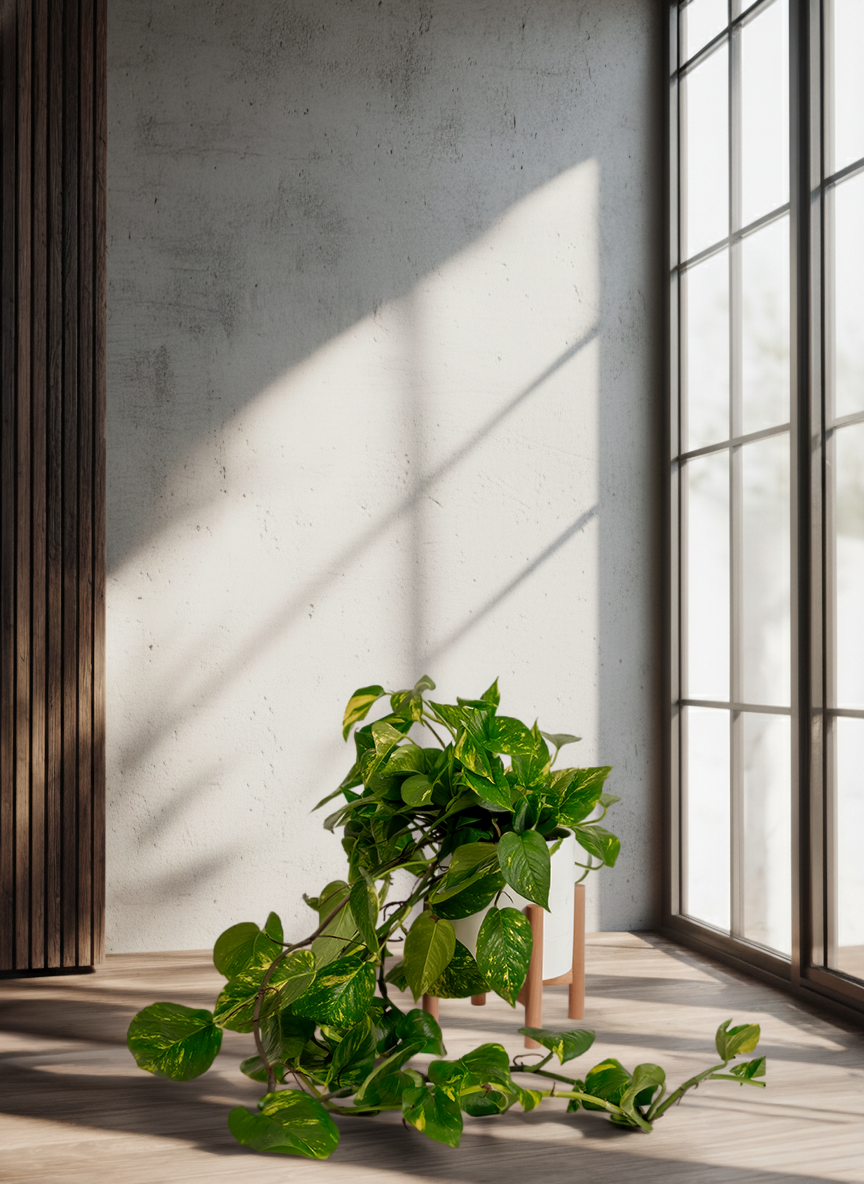
Pothos is the plant everyone says you can't kill, and then everyone kills it the same way: watering too often because the top of the soil looks dry while the bottom is still wet. In a self-watering planter the question goes away. Here's how pothos behaves in a reservoir system, how to set it up, and why it's probably the best first plant to try one with.
Why pothos and self-watering go together
Epipremnum aureum is a vine from the forest floor of Southeast Asia and the Pacific islands. In the wild it grows in leaf litter and over damp rock, roots in constant light moisture, never in standing water. That's the condition a wicking planter reproduces: steady moisture from below with air around the roots. Pothos in soil tolerates neglect; pothos in a self-watering planter actually grows. Expect faster vine extension, bigger leaves, and none of the brown crispy edges that come from drying out.
Setting one up
Pothos is forgiving to repot, which makes it the easiest plant to learn the method on. Pull it from the nursery pot, rinse all the soil off the roots, set it in the black insert, fill around the roots with Grava (our soil-free blend of lava rock and tree fern fiber), drop the insert into the planter and fill the side port until the red gauge reads MAX. Ten minutes. The full steps are in How to repot into a self-watering planter.
Pothos roots fast in Grava. You'll typically see new white roots at the surface within two weeks.
How often you'll refill
A medium pothos in indirect light will go three to four weeks between refills. A large, dense plant in a bright window, closer to three. In the first two weeks refill once or twice while the Grava saturates. Tap water is fine.
Which planter
Pothos trails, so the planter will be seen from the side and below as often as from above. Two things follow from that:
- A Medium is usually right. Pothos root systems stay compact; it's the vines that get long. A Medium Pacific (6.5 in wide, $59) holds a full nursery pot's worth and leaves room to grow.
- Height helps. The Torrey (6.5 in wide x 10 in tall) lifts the plant so the vines fall cleanly, and it's the one we'd pick for a shelf or plant stand. A bamboo stand does the same job for a Pacific.
Golden and Neon pothos behave identically in the system. Marble Queen and other heavily variegated types grow slower but are no fussier.
Three things pothos does in a self-watering planter that look like problems and aren't
- A yellow leaf in week one or two. The plant is swapping soil roots for water roots. One or two older leaves may go. It stops.
- Roots on the surface of the Grava. Pothos roots toward moisture and light. Surface roots are a sign it's happy, not pot-bound.
- Aerial roots on the vines. Normal for the species. Leave them, or tuck long ones back into the Grava and they'll root.
Propagating from a self-watering planter
Cuttings taken from a pothos grown in Grava root faster than cuttings from soil, because the plant already has water roots. Cut below a node, strip the lowest leaf, and push the node into the Grava of the same planter or a new one. It roots in place. No glass of water required.
Frequently asked questions
Can I put several pothos in one planter?
Yes. A Large Pacific or Leucadia holds two or three nursery plants comfortably, and a fuller planter looks better with a trailing plant.
Does pothos need fertilizer in Grava?
Not in the first year. The tree fern fiber in Grava feeds it. After a year, top up the surface inch of Grava with fresh.
Is pothos safe for pets?
No. Pothos is toxic to cats and dogs if chewed. If that matters, a money tree or a moth orchid is pet-safe and does just as well in the system.
Can I buy a pothos already planted?
Yes. Neon Pothos and Golden Pothos ship already growing in the planter of your choice.


